
Measuring coordinated political amplification: what the data shows
A claim has been circulating in Australian political commentary: that a recent surge in political amplification online is not organic but coordinated, manufactured by networks of accounts acting in concert. It is a serious claim, and a measurable one. So we measured it.
We build behavioural detection instruments for exactly this question: not what accounts are saying, but whether they are acting together. Over several weeks we collected and analysed public posting activity around the surging narrative and, as controls, comparable activity around other Australian political figures, plus a longitudinal baseline of ordinary Australian political conversation. We ran the same coordination measurements across all of them.
The result is not a bombshell. On our measurements, the amplification around the surging narrative is no more coordinated than ordinary Australian political conversation, and by several measures less so. We are publishing that because a measured null is a finding, and because the sober answer is harder to find than the alarming one.
What we measured, and against what
We did not investigate any individual or attribute any operation. We measured the shape of the conversation: whether groups of accounts show the behavioural fingerprints that coordinated campaigns produce and organic crowds do not. We used three independent methods, and ran every one identically on the target conversation, on control conversations around other political figures, and on a months-long baseline of everyday political discussion, so that “elevated” always means elevated relative to normal.
The scale, and why we went back to November
This was not a spot check on a few viral posts. We collected and analysed roughly 198,000 public posts across the conversations in scope, about 189,000 on X and 8,600 on YouTube, and generated a machine-readable behavioural embedding for every single one (100 per cent coverage, not a sample). On top of that, we ran deep per-account behavioural analysis on the most active amplifiers in each conversation.
Crucially, we did not just look at the noisy recent weeks. We reached the whole corpus back to 1 November 2025, the point the commentary itself treats as the origin of the story, so we could see the conversation before, during, and after the events that were said to have triggered it. A coordinated operation that “switches on” leaves a visible seam at its start date. Looking only at the surge would have made any conversation look intense; looking across eight months lets the surge be compared against its own quiet baseline. That longitudinal reach is the single most important design choice in the study, and it is why the result can be trusted rather than merely asserted.
The controlled setup
A finding of “high activity” means nothing without something to compare it against, so the study was built as a controlled comparison from the outset, before we saw any results:
- The target conversation, plus two political controls (an equivalent conversation around a major governing-party figure, and one around a minor party), collected on identical keywords, identical budgets, and the identical time window. If the target scored high but the controls scored low, that would point to something specific to the target. If they all scored the same, that points to a property of political conversation in general.
- A longitudinal baseline, months of ordinary Australian political conversation around a mainstream state politician, to anchor what “normal” coordination even looks like on these platforms.
- Three time windows cut the same way for every group: before the initial March reporting, after it, and the recent surge. Same segmentation everywhere, so a rise in one group can be read against the same rise (or absence of it) in the others.
- The exact scoring the product uses in production. We did not build a bespoke metric that could be tuned to a desired answer. We ran the same coordination scan our customers run, at the same thresholds, and only added a date filter. The instrument was fixed before the data was looked at.
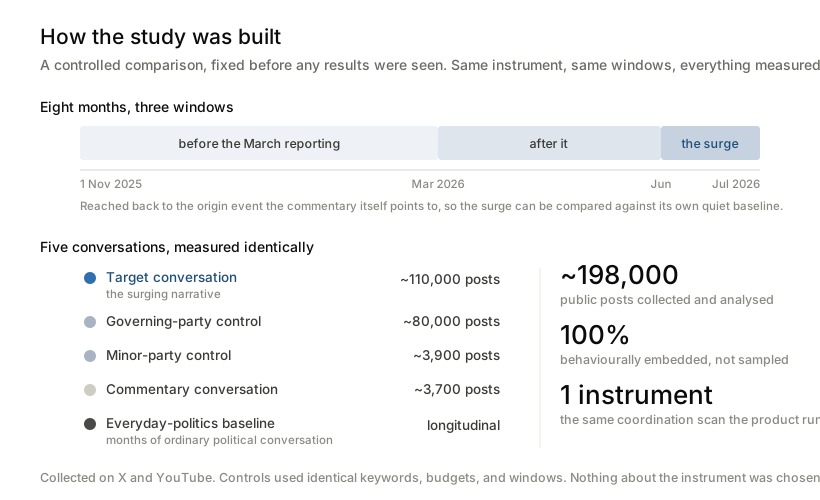
The point of all of this is discipline: controls, a baseline, a fixed instrument, and a reach-back long enough to see a beginning. It is deliberately hard to produce a false alarm with a setup like this, which is exactly why, when it returns a null, the null means something.
Which platforms we measured, and why not Facebook
An honest word on scope, because it matters. We measured public activity on X and YouTube, the platforms where public posting data can be collected within the platforms own terms of service. Some of the reporting that first raised these questions centred on Facebook pages. We did not analyse Facebook, and we are not in a position to: Meta does not make bulk public Facebook post data available for this kind of independent measurement, and its terms of service restrict the programmatic collection that a study like this requires. We work within platform terms, so we measured where we lawfully and technically could.
That boundary cuts two ways, and we want to be plain about both. First, this is not a rebuttal of the Facebook reporting. A financially motivated network of foreign-run Facebook pages, of the kind others have documented, is a real and separate phenomenon on a platform we did not examine; nothing here contradicts it. What we tested is a broader and more recent claim, that the surge in amplification across the public conversation is coordinated, on the open platforms where that conversation is most visible and measurable. Second, it means our null is a null for X and YouTube, and we say so again in the limits below.
If you are a newsroom, researcher, platform, or organisation that wants this analysis extended to other major platforms, including where privileged data access exists that we do not have, reach out to AI Uniti. The method travels; the data access is the constraint.
What the three methods found
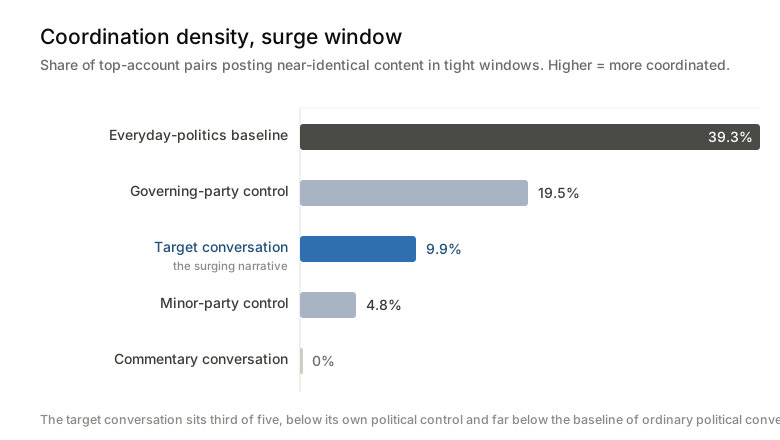
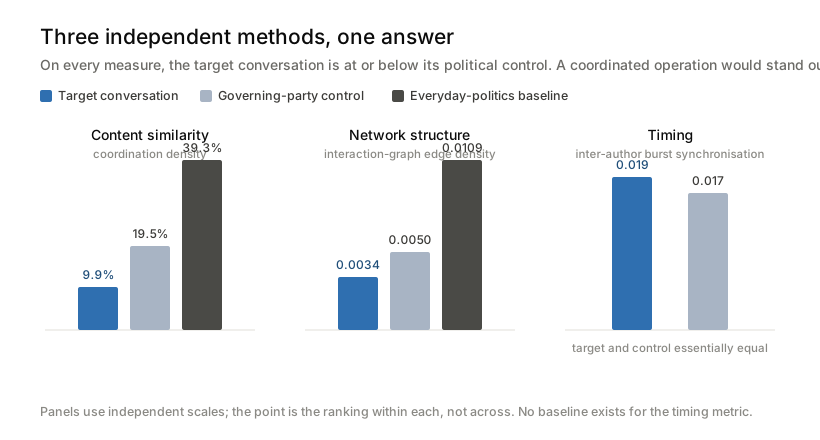
- Coordination density (do clusters of accounts post near-identical content in tight windows?): the target conversation scored lower than the political control and far below the baseline of ordinary political conversation. High similarity turns out to be a property of any active political hashtag, people echo the same talking points, not a signature of orchestration.
- Network structure (do accounts reply to and amplify each other in the tight reciprocal patterns an operation produces?): the target interaction graph was less dense and less reciprocal than the control, with none of the tight mutual-amplification clusters a stood-up network shows.
- Timing (do sets of accounts post in synchronised bursts on a normalised clock?): no synchronised bursting distinct from the controls; posting rhythms were human-shaped, with no round-the-clock or automated cadence.
Three independent lenses, the same answer: the target conversation does not stand out from normal Australian political activity on any of them.
What we did not find, stated plainly
No account-creation-cohort clustering (the signature of a freshly stood-up network). No round-the-clock or automated posting cadence. No abnormally dense mutual-amplification structure. No synchronised bursting beyond the controls. These are precisely the fingerprints a coordinated operation leaves, and we did not see them here. What the activity looks like instead is organic crowds: people arguing, echoing, and repeating, the way real political conversation does.
The honest limits
This is a null for these methods on the platforms we can observe (X and YouTube), not proof that nothing coordinated exists anywhere. As set out above, we did not analyse Facebook, where some of the original reporting was focused and where the data access needed for independent measurement is not available to us. We do not see private channels. Aggregate daily-volume timing is confounded by our own collection method and we deliberately did not lean on it. A measured null means: with strong behavioural instruments, on the observable public conversation, the coordination fingerprints are not present, not that the question is closed forever. We name what we cannot see so the reader can weigh it.
Why we published a null
We sell coordination detection. A finding of coordination would have been better marketing. We are publishing the opposite because the instrument only has value if it reports what the data shows rather than what we would prefer, and because Australian political debate is not helped by unmeasured claims of manipulation in either direction. If the evidence had shown coordination, we would have said so, with the same caveats. It did not, so we say that.
Close
Coordinated manipulation of public conversation is real, it is measurable, and it matters. That is exactly why the measurement has to be disciplined: controls, baselines, stated limits, and the willingness to report a null. On this conversation, by these methods, the amplification looks like Australians arguing about politics, loudly, repetitively, and organically. That is a less exciting story than the headlines. It is also what the data shows.
Frequently Asked Questions
Did AI Uniti find the amplification was coordinated?
No. Across three independent methods it measured no more coordinated than ordinary Australian political conversation, and by several measures less so. The behavioural fingerprints a coordinated operation leaves were not present on the public activity we could observe.
Which platforms were analysed?
Public activity on X and YouTube, where posting data can be collected within the platforms own terms of service. Facebook was not analysed, because the bulk public data access needed for independent measurement is not available to us and its terms restrict the programmatic collection a study like this requires.
Does this contradict the reporting about foreign-run Facebook pages?
No. It is a different platform and a different claim. A financially motivated network of foreign-run Facebook pages, of the kind others have documented, is a real and separate phenomenon on a platform we did not examine. This is our own measurement of a broader claim on the open platforms we can observe, not a rebuttal of that reporting.
What is coordination density?
A measure of how strongly clusters of accounts post near-identical content in tight time windows. High similarity turns out to be a property of any active political hashtag rather than a signature of orchestration. See the glossary for the full definition.